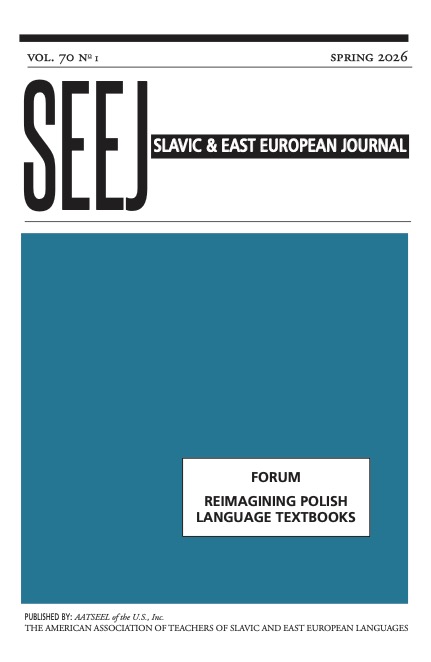
We are pleased to announce the publication of the forum “Reimagining Polish Language Textbooks: Representation, Pedagogy, and Cultural Relevance in the Twenty-First-Century Classroom” in the Slavic and East European Journal 70(1). The first forum of its kind in the field of Polish as a foreign language (PFL) pedagogy, it brings together four original contributions by scholars and educators from Poland and the United States. Through the lenses of representation, pedagogy, and cultural relevance, the forum critically examines Polish language textbooks and explores how contemporary instructional materials can be reimagined to better meet the needs of today’s learners and language classrooms.
In 2024, the North American Association of Teachers of Polish (NAATPl) was represented at the annual meeting of the American Association of Teachers of Slavic and East European Languages (AATSEEL) through a dedicated panel on Polish-language textbooks. Titled “New Approaches to the Old Discourse: How to (Re)Use Old Textbooks in Today’s Polish Language Classroom,” the session featured presentations by six Polish language instructors from Poland and the United States, including the panel organizer, Dr. Ewa Małachowska-Pasek (University of Michigan).
Building on the panel’s discussions, NAATPL subsequently issued a call for papers for a scholarly forum exploring new approaches to historical Polish textbooks and instructional materials. We are pleased to announce that this project has culminated in the publication of a forum featuring four original contributions in the Slavic and East European Journal (volume 70, issue 1), under the title “Reimagining Polish Language Textbooks: Representation, Pedagogy, and Cultural Relevance in the Twenty-First-Century Classroom.” Below, we provide an overview of the forum contributions, including their titles, authors, and abstracts.
Forum: Reimagining Polish Language Textbooks: Representation, Pedagogy, and Cultural Relevance in the Twenty-First-Century Classroom (SEEJ 70/1)
Table of Contents
“Introduction” by Krzysztof E. Borowski (University of Wisconsin–Madison)
Abstract: This article addresses the growing need to redesign Polish as a foreign language (PFL) textbooks to better reflect twenty-first-century Poland’s cultural and social diversity and its Polish-speaking communities abroad. Building on prior studies in Polish language pedagogy, the article highlights the disconnect between popular PFL textbooks and the realities of contemporary Polish-speaking society—whether among heritage speakers, in contemporary Polish lifestyles and cultural landscapes, or in the North American classroom. The article introduces four forum contributions from PFL instructors in Poland and the United States who offer practical insights and teaching scenarios based on their experience with heterogeneous student populations. These contributions advocate for a more representative approach to PFL teaching materials, challenging the conventional underrepresentation of East Asia versus its increasingly visible presence in the Polish cultural landscape, the invisibility of Polish heritage speakers outside of Poland, outdated portrayals of everyday Polish lifestyles, and preference for middle-class views and activities in textbooks. Ultimately, the forum aims to inspire new developments in PFL pedagogy and provide practical strategies for instructors to incorporate these topics into the Polish language classroom.
“Integrating Identity-Based Activities for Polish Heritage Speakers” by Izolda Wolski-Moskoff (University of Chicago)
Abstract: The paper examines the needs and characteristics of Polish heritage speakers in relation to their representations in Polish textbooks currently used in the United States. Polish heritage speakers constitute approximately half of the students enrolled in Polish courses, yet no recent textbooks have been designed specifically for this group. Furthermore, the current Polish textbooks, though developed in Poland, not only fail to address the needs of this audience but also overlook Polish immigrants, who are an integral part of Polish culture. The paper suggests strategies to supplement existing materials, including the incorporation of carnivalesque language and the exploration of regional Polish dialects. Additionally, it highlights the importance of positioning heritage Polish as one of many valid variants of the language rather than a substandard form, while ensuring that the teaching of academic Polish remains uncompromised. By doing so, the paper aims to foster a more inclusive and effective approach to teaching Polish heritage speakers.
“‘My Name is Asia.’ Addressing the Growing Presence of Asians in Poland in Polish Language Learning and Textbooks: Reflections and Recommendations” by Tony H. Lin (Boston College)
Abstract: As Asian cultures gain more exposure and popularity in Poland, it becomes essential to address the lag between the situation on the ground and the curricular materials used in Polish language classes. In the United States, Polish language programs remain relatively insular, populated mostly by students of Polish descent; they struggle to attract students from other backgrounds. While Asians are a growing minority in Poland, they are a significant presence on US college campuses and represent prime targets for recruitment. Given that the Polish language textbooks used in the United States are predominantly published in Poland, this article discusses how Asians are represented in these textbooks and offers suggestions for instructors to broaden the appeal of Polish to students of East Asian descent. Including minorities in more aspects of course curricula not only better reflects Poland’s evolving multicultural society but also is important in broadening the appeal of Polish language programs.
“Contemporary Polish Lifestyle as Reflected in the Latest Polish Neologisms, and their Usefulness for the Teaching of Polish as a Foreign Language” by Justyna Zych (University of Warsaw)
Abstract: The article advocates for the inclusion of the most up-to-date Polish vocabulary, often derived from English words, in textbooks for teaching Polish as a foreign language. The rationale behind this claim is that many recent Polish vocabulary items reflect the contemporary lifestyle of Poles. The article discusses four main groups of neologisms. First, the most productive conjugation pattern, namely infinitives ending in -ować, which includes many verbs referring to Internet and online activities. Second, words with the suffixes -holik/-holiczka, which denote various hobbies and passions. Third, numerous new culinary terms that reflect Poles’ preference for foreign cuisines as well as the growing importance of vegetarianism and veganism in Poland. Finally, the article analyzes the phenomenon of hybrid words combining Polish roots with the English gerund ending -ing, often used to describe leisure activities. The article argues that incorporating the newest Polish vocabulary into Polish as a foreign language classes would help present a more accurate depiction of Polish society today.
“Textbook Middle Class: Investigating Class Representation in Polish Language Education through Textbook Categorical Discourse Analysis (TCDA)” by Krzysztof E. Borowski (University of Wisconsin–Madison)
Abstract: Despite its relevance to equity and inclusion, social class remains an underexamined dimension in foreign language education and applied linguistics. This article investigates how Polish as a foreign language (PFL) textbooks—particularly the widely used Hurra!!! Po polsku series—embed and promote middle-class cultural norms aligned with Poland’s intelligentsia. Using the Textbook Categorical Discourse Analysis (TCDA) framework, the study analyzes language acquisition tasks to reveal how these materials reflect and reinforce class-based assumptions that may not align with the diverse backgrounds of learners, especially in non-European contexts such as North American universities. The article concludes with pedagogical recommendations and a sample lesson scenario aimed at helping educators critically engage with representations of social class in PFL instruction, offering a model that can be adapted to other languages and educational settings.
Subscribe to email updates from naatpl
Subscribe below to receive updates on new posts, including event and competition announcements, Polish teaching job openings, enrollment surveys, publications, blog articles on teaching Polish as a foreign language, and other news from the North American Association of Teachers of Polish.