The results of the 2025 NAATPl survey on Polish language enrollment are now available. This report analyzes the findings, presents them in both textual and visual formats, and offers a range of downloadable graphs and charts. It also features contributions from instructors, including textbooks and other materials used, additional teaching opportunities, and a list of scholarships for students enrolled in Polish language courses at the college and university level.
A print-ready PDF version of the report is also available for download here: 2025 NAATPl Polish Language Enrollment Survey Report.
To share this report on LinkedIn, click here.
To share this report on Facebook, click here.
- Introduction
- Majors, Minors, Concentrations, and Certificates
- Enrollments
- General overview
- Figure 2: Total Polish enrollment in 2025
- Institutions meeting or exceeding average enrollment
- First-year Polish language enrollment
- Figure 3: First-year Polish enrollment
- Second-year Polish language enrollment
- Figure 4: Second-year Polish enrollment
- Third-year and above Polish language enrollment
- Figure 5: Third-year and above Polish enrollment
- Textbooks
- Additional Learning Opportunities
- Additional Teaching Materials
- Funding and Scholarships
- Conclusions
- Downloads
- Author
- Acknowledgements
- How To Cite This Report
Introduction
Preliminary remarks
In 2025, the NAATPl Polish Language Enrollment Survey was distributed to 39 institutions of higher education across Canada and the United States that have active or recently active Polish language programs. The survey was sent via both mass and individual emails to college and university instructors and administrators. Of the 39 programs contacted, we received 28 responses, resulting in a response rate of nearly 72 percent.
The initial invitation to participate was sent in late October, and the survey closed in early December. Preliminary results were presented and discussed during a December 4 webinar. We would like to thank everyone who contributed to the 2025 survey or helped spread the word about it.
To submit a suggestion for the 2025 survey or future surveys, please contact us.
Report organization and navigation
The 2025 report is organized in the following sections:
- Introduction
- Majors, Minors, Concentrations, and Certificates
- Enrollments
- Textbooks
- Additional Learning Opportunities
- Additional Teaching Materials
- Funding and Scholarships
- Conclusions
- Downloads
- Author
- Acknowledgments
- How To Cite This Report
To navigate this report, use the table of contents above to browse the main sections and subsections. Clicking any title will take you directly to that section. To return to the top of the page, click the red button with the white arrow in the bottom-right corner. To share a direct link to any section, copy its link address from the table of contents.
Institutions participating in the 2025 survey
- Boston College
- Brown University
- Cornell University
- Georgetown University
- Harvard University
- Indiana University
- Loyola University Chicago
- Northwestern University
- Rutgers University
- Stanford University
- University at Buffalo
- University of California, Berkeley
- University of California, Los Angeles
- University of Chicago
- University of Illinois Chicago
- University of Illinois Urbana-Champaign
- University of Kansas
- University of Massachusetts Amherst
- University of Michigan
- University of North Carolina at Chapel Hill
- University of Pittsburgh
- University of Rochester
- University of Southern California
- University of Texas at Austin
- University of Toronto
- University of Virginia
- University of Washington
- University of Wisconsin–Madison
Polish program closure at Wayne State University
One institution that did not report its Polish enrollment was Wayne State University in Detroit, MI, where the Polish program became inactive following the retirement of its longstanding lecturer, Dr. Alina Klin, Associate Professor of Teaching in Polish, who retired in May 2023. As of January 2026, no Polish language or culture courses are offered at Wayne State. Nevertheless, the university’s Department of Classical and Modern Languages, Literatures, and Cultures still lists Polish as one of its available minors. Dr. Klin, a NAATPl member, recently confirmed the discontinuation of Polish language instruction at Wayne State where it had been continuously offered since 1947.
Majors, Minors, Concentrations, and Certificates
General overview
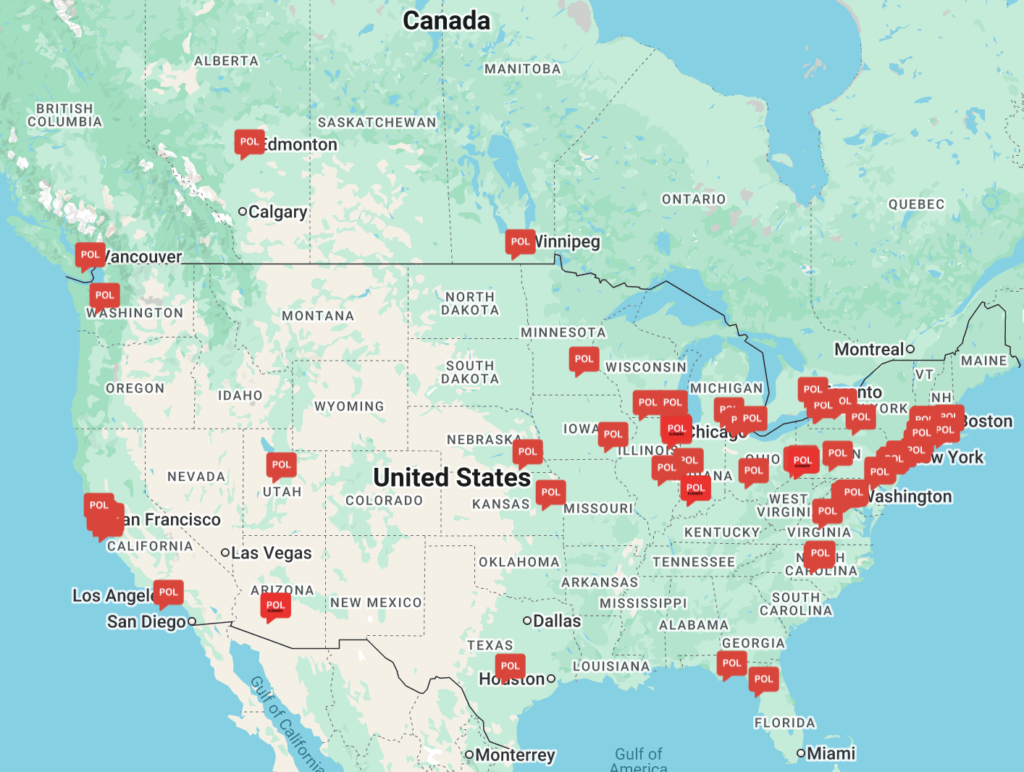
Polish language courses are offered as part of a variety of academic credentials at North American colleges and universities. These include majors, minors, certificates, and concentrations—both as standalone programs and under the broader umbrella of Central European, East European, European, or Slavic Studies. It is also common for Polish to appear in more than one category at the same institution, and varying institutional requirements make comparisons across programs relative. For a map of Polish language programs prepared by Heidi Lernihan, click the map below or see here.
Below is a summary of the credentials reported in the 2025 survey.
Majors
The following institutions offer a Polish major either as a standalone degree or as part of a broader program:
- Boston College
- Indiana University
- Loyola University Chicago
- University of Illinois Chicago
- University of Kansas
- University of Massachusetts Amherst
- University of Michigan
- University of Southern California
- University of Toronto
- University of Wisconsin–Madison
Minors
The following institutions offer a Polish minor either as a standalone credential or as part of a broader program:
- Boston College
- Indiana University
- Loyola University Chicago
- Rutgers University
- University at Buffalo
- University of California, Los Angeles
- University of Chicago
- University of Illinois Chicago
- University of Illinois Urbana-Champaign
- University of Kansas
- University of Massachusetts Amherst
- University of Michigan
- University of Pittsburgh
- University of Texas at Austin
- University of Toronto
- University of Virginia
- University of Washington
Concentrations
The following institutions offer a concentration in Polish as part of a broader credential in Slavic or another subject:
- Brown University
- Northwestern University
- Stanford University
- University of California, Berkeley
- University of Illinois Urbana-Champaign
- University of Virginia
Certificates
The following institutions offer a certificate in Polish:
- University of California, Los Angeles
- University of Rochester
Enrollments
General overview
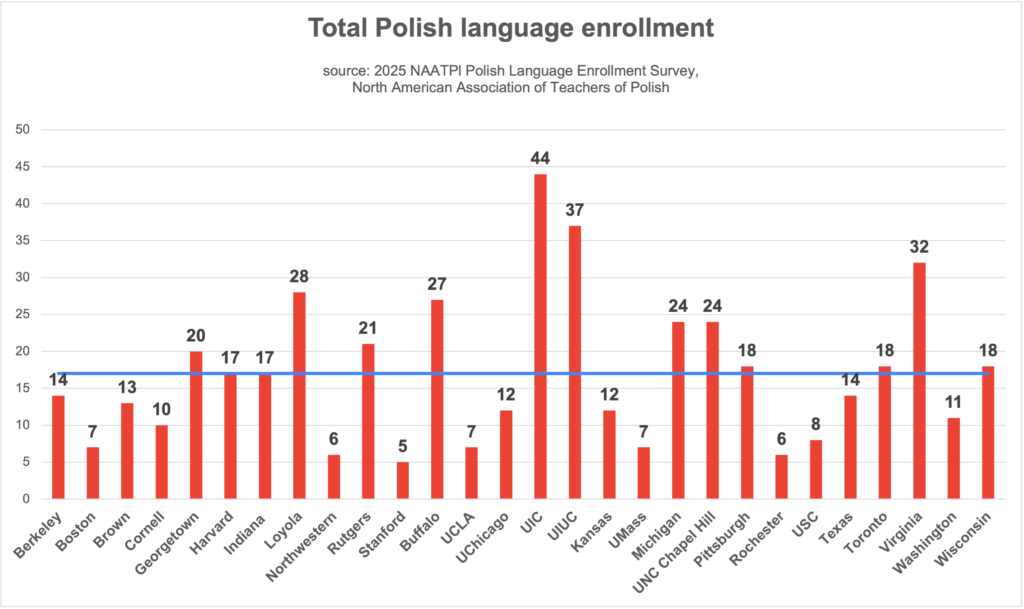
Polish enrollment at North American colleges and universities remains strong overall, reflecting continued student interest in learning the language and culture. Institutions across Illinois dominate in total numbers, with two campuses of the University of Illinois system taking the top two spots. The third position went to the University of Virginia, which in 2025 recorded the highest Polish enrollment in the Slavic department’s history. Beyond these leaders, another tier of institutions with solid enrollment emerges, comprising a mix of major public and private universities. In general, private institutions reported lower Polish enrollment in this survey.
The average total Polish enrollment (including first-year, second-year, and third-year or higher levels, where applicable) stands at 17 students (marked by a blue line below). This average divides the surveyed institutions into two groups: those with overall enrollment at or above 17 (see the full list below) and those below it. While useful, this figure should be considered a relative measure of a Polish program’s current strength.
Figure 2: Total Polish enrollment in 2025
Note: The blue line indicates the overall survey average of 17 students across all language levels at each institution.
Note: To download the full-size graph image, click here.
Institutions meeting or exceeding average enrollment
- Georgetown University
- Harvard University
- Indiana University
- Loyola University Chicago
- Rutgers University
- University at Buffalo
- University of Illinois Chicago
- University of Illinois Urbana-Champaign
- University of Michigan
- University of North Carolina Chapel Hill
- University of Pittsburgh
- University of Toronto
- University of Virginia
- University of Wisconsin–Madison
First-year Polish language enrollment
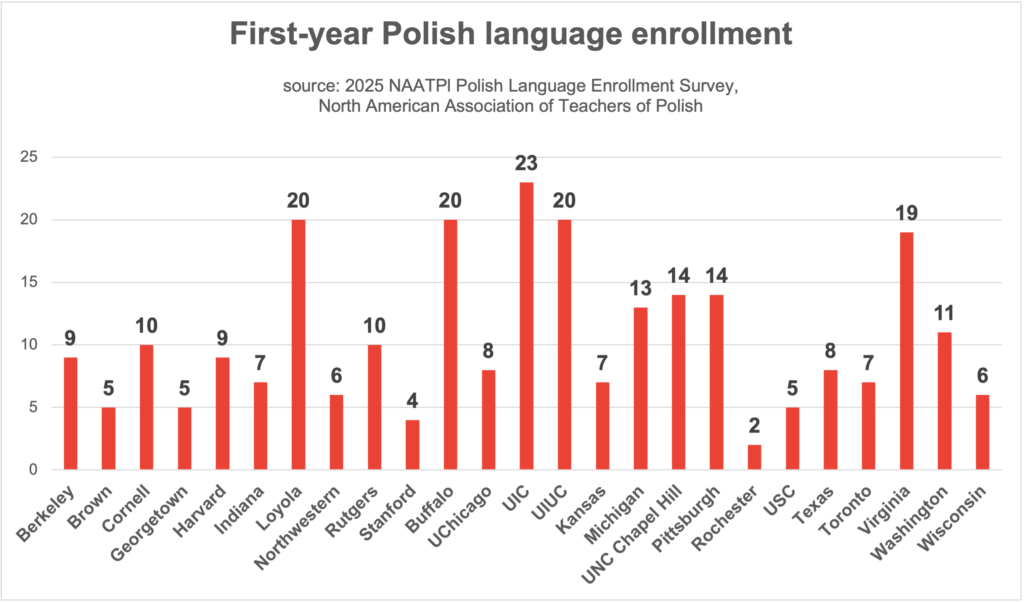
Of the 28 institutions surveyed, 25 (just over 82 percent) reported offering first-year Polish courses. The University of Virginia enrolled 19 students at this level, placing just behind Loyola University Chicago, University at Buffalo, and the University of Illinois Urbana-Champaign, each with 20 students. The top spot went to the University of Illinois Chicago with 23 first-year students. Institutions not offering this level include Boston College, University of California, Los Angeles, and the University of Massachusetts Amherst.
A total of 262 students enrolled in elementary Polish courses, resulting in an average of 10.5 students per course. This average was reached at the University of Michigan, University of North Carolina Chapel Hill, University of Pittsburgh, and University of Washington, among others. Cornell University and Rutgers University followed closely with 10 students each.
Figure 3: First-year Polish enrollment
Note: To download the full-size graph image, click here.
Second-year Polish language enrollment
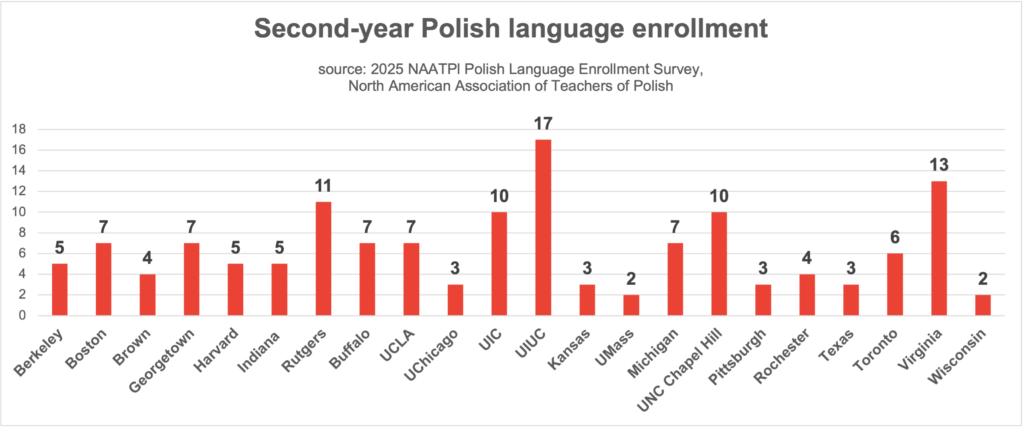
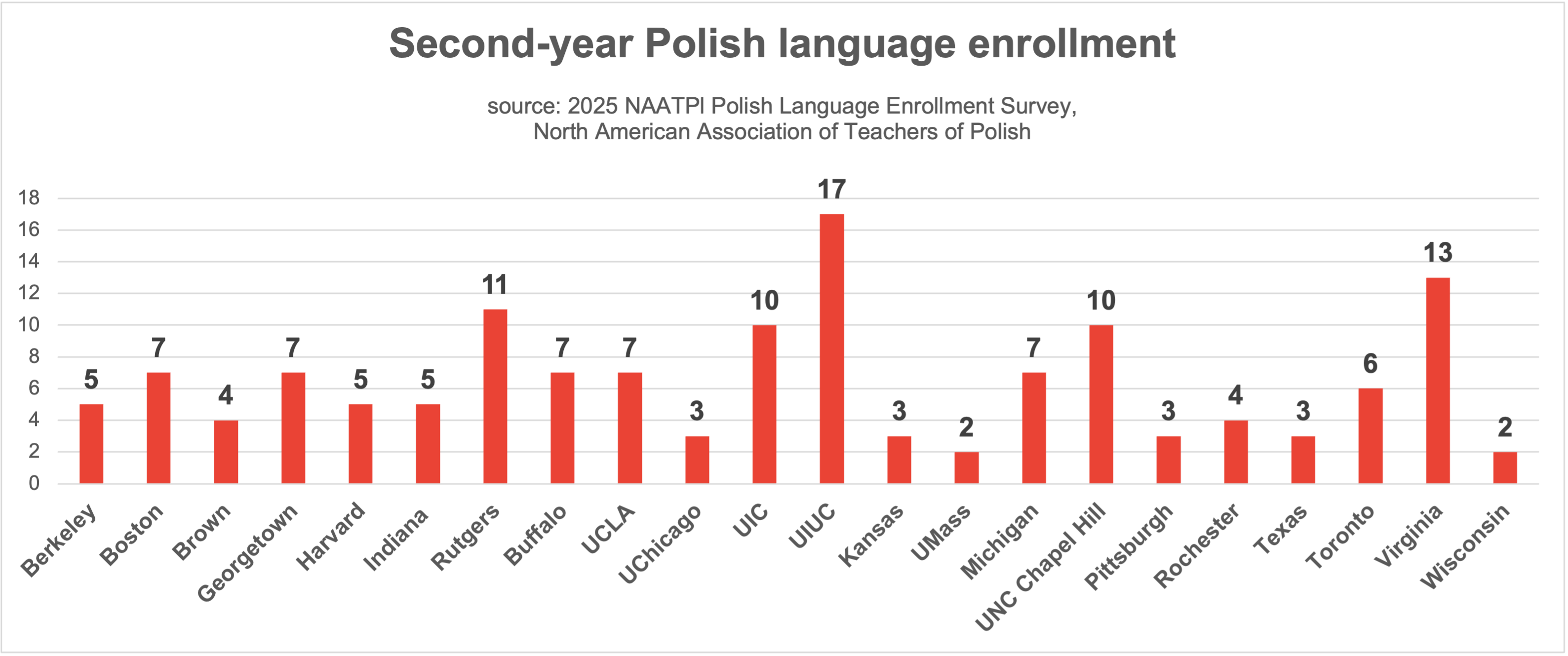
Twenty-two institutions (78.6 percent) reported offering second-year Polish courses. The top three enrollments at this level were at the University of Illinois Chicago (17 students), University of Virginia (13 students), and Rutgers University (11 students). Two other public institutions—the University of Illinois Urbana-Champaign and University of North Carolina Chapel Hill—recorded strong enrollment with 10 students each. Six institutions did not offer Polish at this level: Cornell University, Loyola University Chicago, Northwestern University, Stanford University, University of Southern California, and University of Washington.
A total of 141 students enrolled in intermediate Polish courses, producing an average of 6.4 students per course. This average was reached at Boston College, Georgetown University, University at Buffalo, University of California, Los Angeles, and University of Michigan. The University of Toronto, with 6 students, fell just below the average.
Figure 4: Second-year Polish enrollment
Note: To download the full-size graph image, click here.
Third-year and above Polish language enrollment
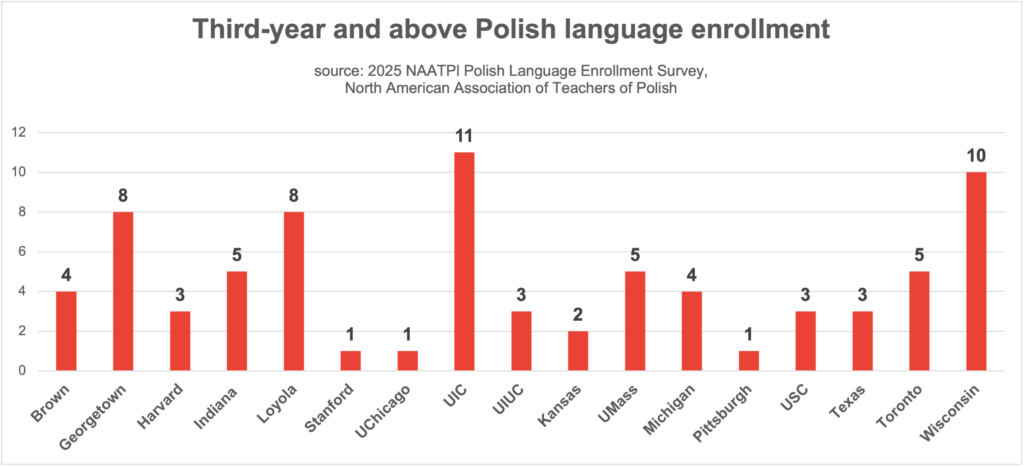
Seventeen institutions (about 60 percent) reported offering third-year or higher-level Polish courses. Because institutions do not always offer or distinguish between third- and fourth-year courses, the survey combined enrollment for these levels. The University of Illinois Chicago led with 11 students, followed by the University of Wisconsin–Madison (10 students) and two private institutions—Georgetown University and Loyola University Chicago—each with 8 students.
A total of 77 students enrolled in advanced Polish courses, resulting in an average of 4.5 students per course. This average was reached at Indiana University, University of Massachusetts Amherst, and University of Toronto. Brown University and University of Michigan followed closely with 4 students each.
Figure 5: Third-year and above Polish enrollment
Note: To download the full-size graph image, click here.
Textbooks
General overview
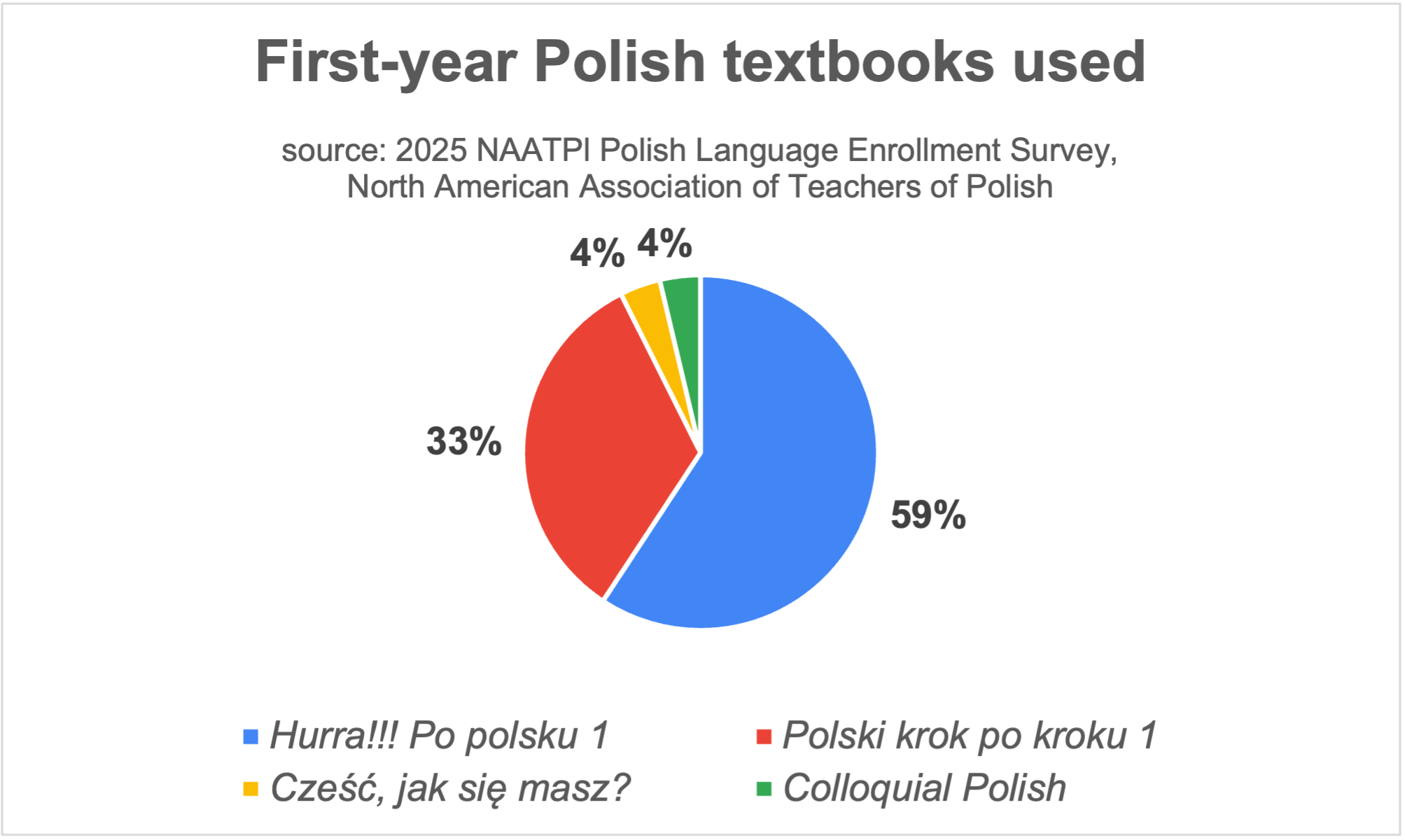
Textbooks used to teach Polish as a foreign language tend to revolve around two leading series: Hurra!!! Po polsku by Prolog and Polski krok po kroku by Glossa. Together, these two titles are chosen by over 90 percent of instructors for first-year Polish courses and more than 80 percent for second-year courses.
The third most common choice among surveyed programs is self-created materials, which account for only 4 percent at the elementary level but rise to 45 percent at the advanced level—making them the most popular option at that stage and surpassing the Hurra!!! Po polsku 3 textbook. This trend also suggests a need for more textbooks designed for upper-intermediate and advanced Polish learners.
Figure 6: First-year Polish textbooks
Note: To download the full-size chart image, click here.
Figure 7: Second-year Polish textbooks
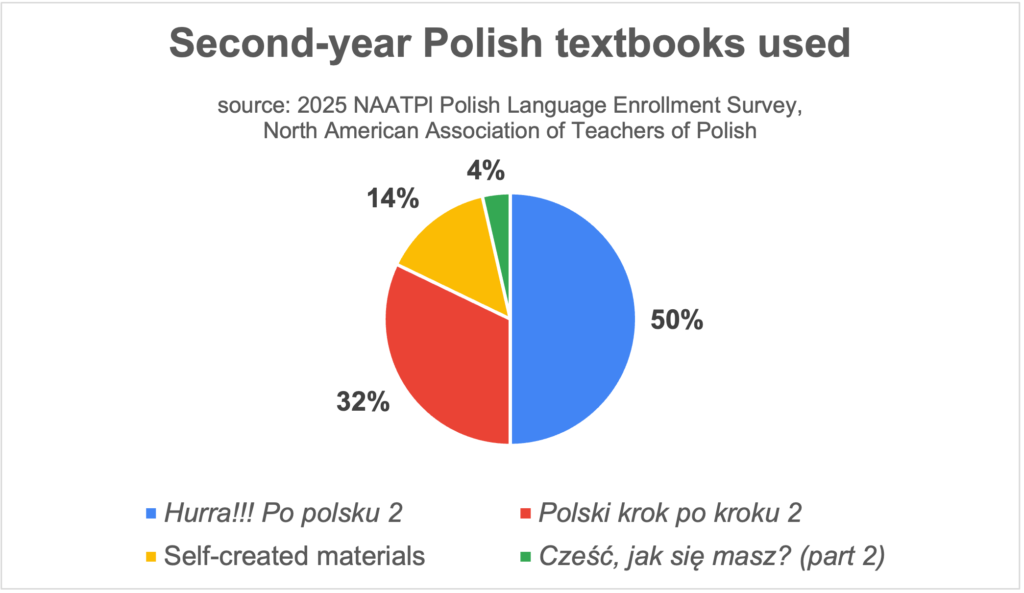
Note: To download the full-size chart image, click here.
Figure 8: Third-year Polish textbooks
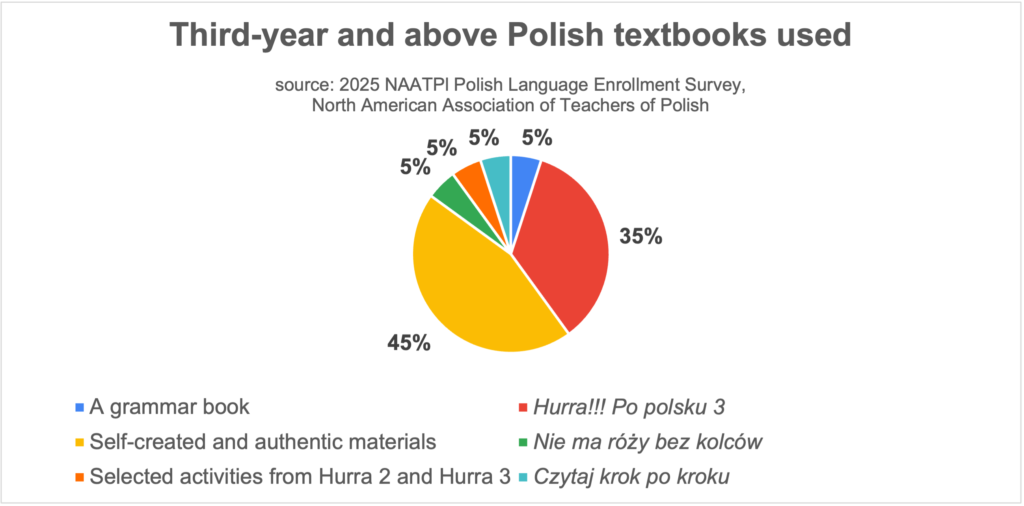
Note: To download the full-size chart image, click here.
Additional Learning Opportunities
General overview
In addition to regular classroom instruction, surveyed programs offer a variety of opportunities to engage with Polish language and culture. The ones mentioned by name include conversation meetings, events with invited guests, film screenings, and student clubs or organizations. Among these, language tables and conversational hours were the most frequently mentioned, cited by 50 percent of respondents. Polish clubs and student organizations ranked second, followed by film screenings in various formats.
Figure 9: Additional learning opportunities
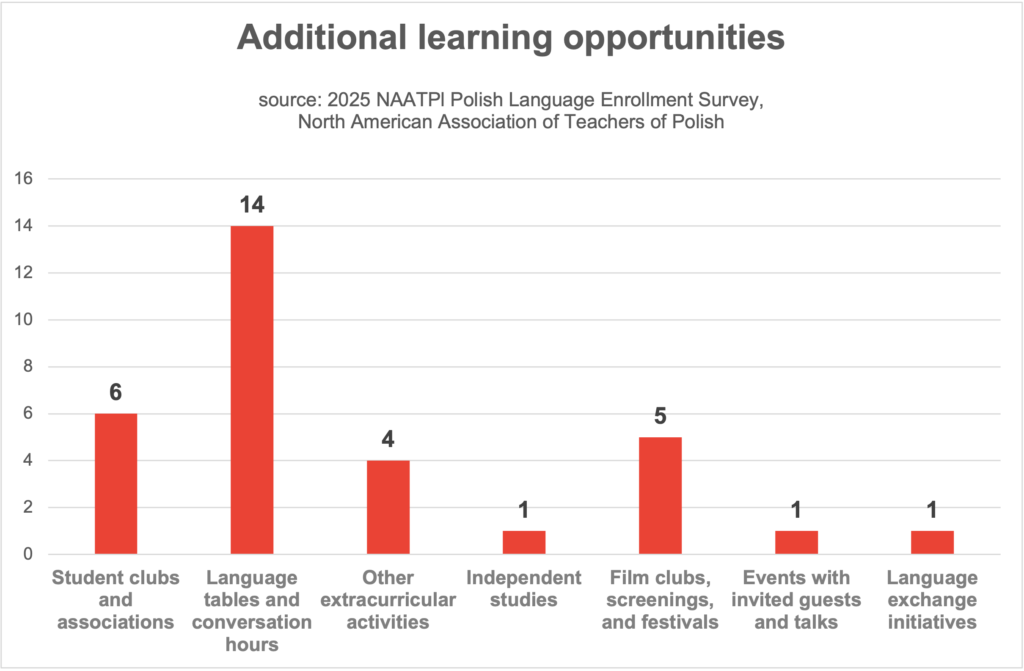
Note: To download the full-size graph image, click here.
Additional Teaching Materials
General overview
While the number of popular textbooks for teaching Polish as a foreign language is relatively limited, the opposite is true for language pedagogy and grammar books used alongside those textbooks. In fact, respondents to the 2025 survey listed about 20 titles in each of these two categories, highlighting the abundance of supplementary resources that support learning and practicing Polish. Beyond guides published as part of established textbook series such as Hurra!!! Po polsku and Polski krok po kroku, there are numerous books focused on specific skills or grammar practice that instructors readily incorporate into their classrooms.
Grammar books
- Dana Bielec, Basic Polish: A Grammar and Workbook
- Dana Bielec, Intermediate Polish: A Grammar and Workbook
- Dana Bielec, Polish: An Essential Grammar
- Kamila Dembińska, Karolina Fastyn-Pleger, Agnieszka Małyska, Marta Ułańska, Gramatyka dla praktyka
- Joanna Machowska, Gramatyka? Ależ tak!
- Joanna Machowska, Gramatyka? Dlaczego nie?!
- Liliana Madelska with Geoffrey Schwartz, Hurra!!! Discovering Polish: A Learner’s Grammar
- Bartłomiej Maliszewski, Gramatyka z kulturą
- Władysław Miodunka, Cześć, jak się masz?
- Polonicum, “Polski z Anią” YouTube series
- Iwona Sadowska, Polish: A Comprehensive Grammar
- Alexander M. Schenker, Beginning Polish (vols. 1, 2)
- Anna Stelmach and Iwona Stempek, Polski krok po kroku. Tablice gramatyczne
- Oscar E. Swan, A Concise Grammar of Polish
- Oscar E. Swan, A Grammar of Contemporary Polish
- Oscar E. Swan, First Year Polish
- Oscar E. Swan, Polish Grammar in a Nutshell
Additional books
- Czytaj po polsku series (Wydawnictwo Uniwersytetu Śląskiego)
- Agnieszka Dixon, Agnieszka Jasińska, Hurra!!! Po polsku 2
- Marta Galewska-Kustro, Pucio series
- Marek Gołkowski, Anna Kiermut, Maria Kuc, Małgorzata Majewska-Meyers, Gdybym znał dobrze język polski…
- Izabela Górnicka-Zdziech, Polska mozaika filmowa
- Wioletta Gurdak, Wojciech Sosnowski, Polskie czytanki
- Klara Janecki, 301 Polish Verbs
- Clara Kaipio, 201 Polish Verbs
- Joanna Machowska, Gramatyka? Ależ tak!
- Joanna Machowska, Gramatyka? Dlaczego nie?!
- Liliana Madelska with Geoffrey Schwartz, Hurra!!! Discovering Polish: A Learner’s Grammar
- Małgorzata Małolepsza, Aneta Szymkiewicz, Hurra!!! Po polsku 1
- Stanisław Mędak, Liczebnik też się liczy. Gramatyka liczebnika z ćwiczeniami
- Małgorzata Pasieka, Język polski dla cudzoziemców
- Józef Pyzik, Przygoda z gramatyką
- Anna Seretny, Kto czyta – nie błądzi. Podręcznik do nauki języka polskiego
- Anna Seretny, Per aspera ad astra. Podręcznik do nauki języka polskiego
- Iwona Stempek, Anna Stelmach, Sylwia Dawidek, Aneta Szymkiewicz, Polski, krok po kroku
- Anna Stelmach, Czytaj, krok po kroku
- Renata Szpigiel, Gramatyka
- Weronika Wilczyńska, Teksty z ćwiczeniami, Rok w Polsce, Czytam po polsku
Digital resources
The wealth of supplementary books is complemented by numerous digital and online resources, including reputable sources of current news and cultural content (Culture.pl, Polska Agencja Prasowa), online dictionaries and translators (DeepL.com, Diki.pl), Polish language-focused video and podcast series (EasyPolish, HelloPolish podcast, Polski z Anią from Polonicum), in addition to freely available teaching materials and online learning modules (Polski.info, PolskiNaWynos.com, Po polsku po Polsce), language games (Słowle), and tools for creating learning activities (LearningApps, Wordwall). Created by both professionals and language enthusiasts, these resources expand the variety of input available to learners, exposing them to content that resonates more strongly with today’s college-age generation.
Authentic materials
The survey shows that Polish instructors actively incorporate authentic teaching materials into their courses. Among these, video and audio content were the most frequently cited, with 27 and 25 mentions, respectively. Literature and films followed, each with 20 mentions, while news websites and blogs received 19 mentions. Of the 11 categories listed, 7 were mentioned by at least 50 percent of respondents (respondents could select more than one option), indicating that a wide variety of authentic materials are being used in North American Polish classrooms.
Figure 10: Authentic materials
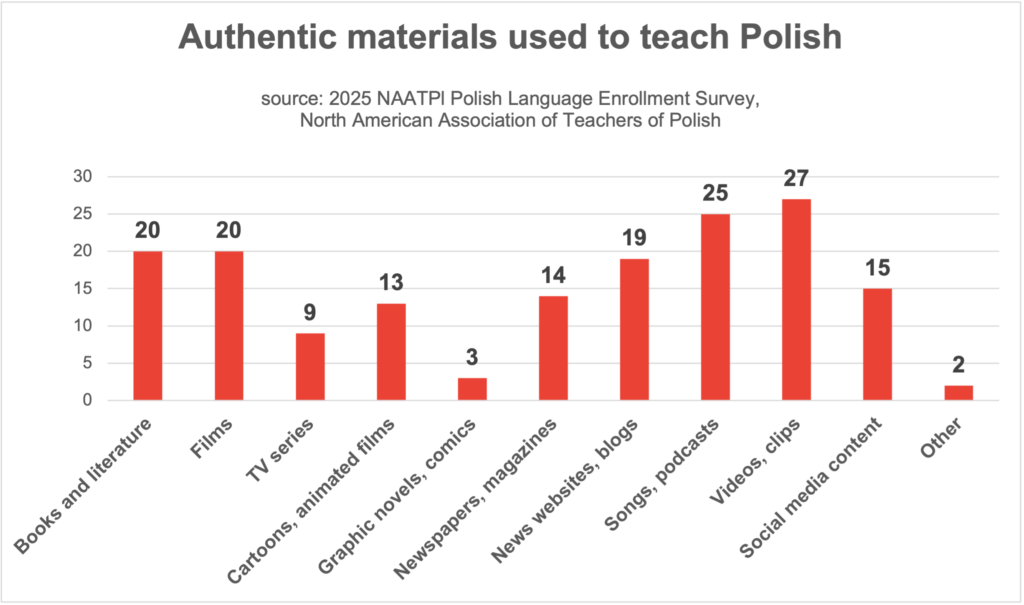
Note: To download the full-size graph image, click here.
Funding and Scholarships
General overview
Among the funding and scholarship opportunities mentioned in the survey, two sources of financial support for Polish students stood out: the Kosciuszko Foundation and the Polish National Agency for Academic Exchange (NAWA). Respondents also cited national scholarships such as Fulbright, Boren, Critical Language Scholarship, and Foreign Language & Area Studies (FLAS), along with regional awards offered by organizations in Buffalo, Chicago, Massachusetts, Michigan, and Wisconsin.
This picture is further complemented by internal funding opportunities, the availability of which depends on individual programs and their institutions. Current and future Polish students are strongly encouraged to contact their instructors to learn more about existing internal and external funding opportunities to support their study of Polish language and culture locally, nationally, and abroad.
List of funding and scholarship opportunities
- Kosciuszko Foundation
- Polish National Agency for Academic Exchange (NAWA)
- Fulbright U.S. Student Program
- Boren Awards
- Critical Language Scholarship
- Foreign Language and Area Studies (FLAS) Program
- PSFCU Scholarship Program
- Pulaski Association Scholarship
- Polish Arts Club of Buffalo Scholarship
- Chicago Society Foundation Kulze Scholarship
- Heritage Polonia
- Lemanski Family Scholarship (Massachusetts)
- Polanki College Achievement Awards (Wisconsin)
- Polish Heritage Club of Madison Scholarship (Wisconsin)
- American Council for Polish Culture Scholarships
Conclusions
The North American Association of Teachers of Polish continues its mission to monitor Polish language programs in Canada and the United States. The 2025 survey reflects sustained efforts to offer Polish as a foreign language across North America. Instructors provide students with multiple ways to engage with Polish language and culture, often while being the sole person responsible for both instruction and extracurricular activities. Institutions report steady enrollment numbers, and overall interest in learning Polish at the post-secondary level appears to be growing, according to SRAS.
A notable trend is the extensive use of supplementary publications by Polish instructors in their teaching practice. This is complemented by a growing effort to create digital-first materials in audio, video, and other formats. The availability of modular, free online courses such as Po polsku po Polsce and Polski.info suggests that learning Polish is increasingly positioned as a consumer-friendly product—an attractive offering given Poland’s continued rise into the world’s top 20 economies. While structural and demographic challenges facing the higher education remain, we hope these positive trends will continue in the years ahead.
The 2026 edition of the NAATPl Polish Language Enrollment Survey is scheduled for release in October 2026, with an online event summarizing its results planned for early December. While the core questions will remain the same, we plan to review the current set and to introduce more related questions in future iterations of the survey.
Downloads
Full Report PDF
2025 NAATPl Polish Language Enrollment Survey Report [PDF file]
Graphs and Charts
- Total Polish language enrollment in the United States and Canada
- First-year Polish language enrollment in the United States and Canada
- Second-year Polish language enrollment in the United States and Canada
- Third-year and above Polish language enrollment in the United States and Canada
- First-year Polish language textbooks used in the United States and Canada
- Second-year Polish language textbooks used in the United States and Canada
- Third-year and above Polish language textbooks used in the United States and Canada
- Additional Polish learning opportunities in the United States and Canada
- Authentic materials used to teach Polish language in the United States and Canada

Author
Krzysztof E. Borowski
Assistant Teaching Professor, University of Wisconsin–Madison
President, North American Association of Teachers of Polish
borowski3@wisc.edu
Acknowledgements
With thanks to members of the NAATPl Executive Board for helpful feedback on survey design and questions.
How To Cite This Report
Borowski, Krzysztof E. 2025 NAATPl Polish Language Enrollment Survey Report. North American Association of Teachers of Polish, January 2, 2026. https://naatpl.org/2025-naatpl-polish-language-enrollment-survey-report.
Note: This report has been amended on January 13, 2025, to correctly reflect the authorship of the map of Polish programs.
Subscribe to email updates from naatpl
Subscribe below to receive updates on new posts, including event and competition announcements, Polish teaching job openings, enrollment surveys, publications, blog articles on teaching Polish as a foreign language, and other news from the North American Association of Teachers of Polish.